
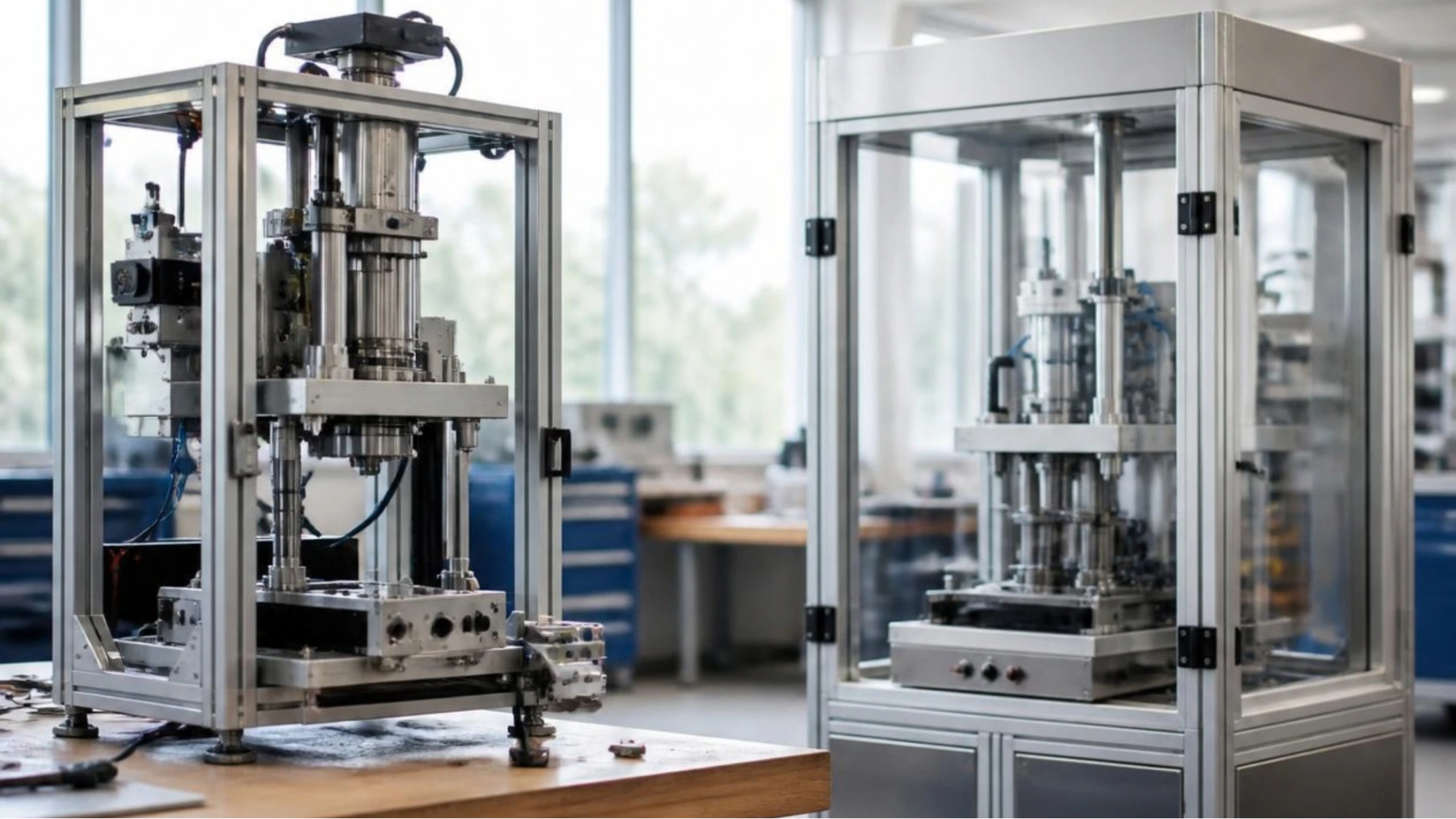
The prototype runs. It cycles, it holds position, and it produces the part it was built to produce. Everyone in the room relaxes. Then someone asks the question that changes the project: “Great. Can we build ten more?”
That question exposes something many manufacturers learn the hard way. A working prototype proves that a concept is possible. It does not prove that the machine can be built again and again, at a sensible cost, safely, and by people who were never in the room when the first one came together. Moving from prototype to production is its own engineering phase. Treating it as an afterthought is one of the most expensive mistakes in custom machine design.
If you have already read our guide on the journey from concept to prototype, this is the next chapter. Here is what it really takes to scale a custom machine.
Why a Working Prototype Is Not a Production-Ready Machine
Prototypes are built to answer questions quickly, and that goal shapes every decision along the way. Parts are hand-fitted, shimmed, or modified on the bench. Components are swapped based on what is in stock. Tolerances are loose because the builder can adjust as needed. Most importantly, much of the critical knowledge lives in the heads of the people who built it.
Production demands the opposite. Every part must be made the same way every time, by any qualified shop, from documentation alone. The distance between those two realities is where cost overruns, delays, and field failures begin.
The Five Gaps Between Prototype and Production
1. Manufacturability
A part that a skilled machinist can make once is not always a part that can be made affordably at volume. Complex geometry, unnecessarily tight features, non-standard fasteners, and parts that need multiple setups all add cost to every unit. Applying design for manufacturability principles before release lets you simplify parts, standardize hardware, and cut machining and assembly time without compromising function.
2. Tolerances and GD&T
On a prototype, fit problems get solved with a file and a shim. In production, they show up as scrapped parts and rework. Clear tolerancing allows parts from different suppliers and different batches to assemble correctly the first time. Our article on why GD&T makes or breaks your manufacturing explains how geometric dimensioning and tolerancing communicates design intent. Professional drafting, GD&T, and manufacturing drawings turn that intent into instructions every shop can follow.
3. Structural and Thermal Validation
A prototype may run a few hundred cycles during testing. A production machine may run for years under full load, across multiple shifts, in conditions the prototype never saw. Finite element analysis identifies stress concentrations, fatigue risks, and deflection issues before they appear in the field. If your machine generates or is exposed to heat, thermal management design belongs in this stage too, not after the first overheating complaint.
4. Safety and Compliance
Guarding, emergency stops, lockout points, and pinch point protection are often simplified or missing on early prototypes. A machine going onto customer floors must meet applicable safety standards and be designed around the people who operate it. Building risk mitigation into the design costs far less than retrofitting it after installation.
5. Documentation That Travels Without You
This is the gap most often underestimated. A production-ready machine needs a complete technical package: 3D models, fully dimensioned manufacturing drawings, a controlled bill of materials, assembly instructions, and a revision history. Without it, every new build depends on a few people remembering how it was done last time. With it, you own a repeatable asset that any qualified fabricator can produce. That package is not paperwork. It is lasting business value.
A Practical Roadmap for Scaling a Custom Machine
- Freeze the requirements. Confirm performance targets, production volumes, operating environment, and cost targets before redesign begins. Shifting requirements mid project is the fastest way to lose a schedule.
- Run a formal prototype review. Record every modification, workaround, and fix made during testing. Each one is a design change waiting to be captured.
- Redesign for production. Apply DFM, standardize components, and resolve every workaround in the model itself. Revisit material choices as well; our guide on how mechanical designers choose the right materials outlines the tradeoffs.
- Validate before you commit. Run FEA and, where relevant, thermal analysis on the revised design. Confirm safety requirements are met.
- Build a pilot unit. Produce one machine using only the released documentation. Any question the builder has to ask points to a gap in the package.
- Release the production package. Finalize drawings, BOM, and assembly documentation under revision control so every future build matches the approved design.
Common Mistakes That Stall Scale-Up
- Treating prototype drawings as production drawings
- Skipping tolerance analysis because the prototype “fit fine”
- Keeping custom or single source components that could be standardized
- Leaving assembly knowledge undocumented
- Starting production before validation is complete to hit a launch date
Each of these saves a little time early and costs significantly more later.
Design the Second Machine, Not Just the First
Scaling is also the right moment to think beyond the current order. Customers may need variations in size, capacity, or tooling. A modular machinery design approach lets you configure variants from a common platform instead of engineering each one from scratch, and it makes future upgrades far simpler. That decision is much easier to make during the production redesign than after the fifth build.
How CustoMachinery Supports the Move to Production
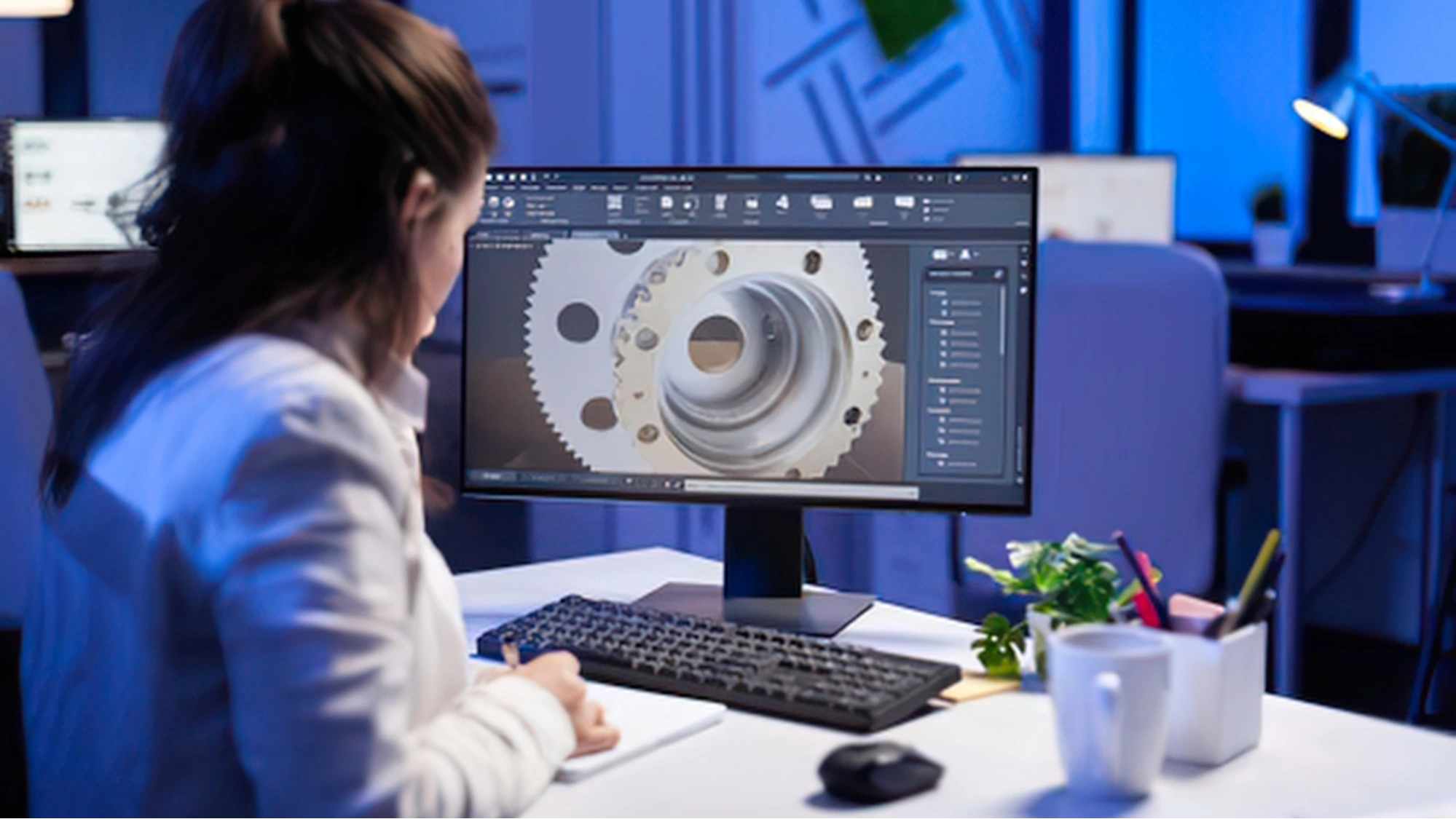
CustoMachinery is a Mississauga-based mechanical engineering design consultancy with more than 22 years of experience in custom machinery and industrial equipment design. We are authorized by Professional Engineers Ontario to offer professional engineering services. Our role is to deliver the engineering that makes production possible: prototype design reviews, DFM redesign, CAD, 3D modeling, and FEA, and complete manufacturing drawing packages.
When clients need parts made, we can connect them with our established network of service providers for rapid prototyping, CNC machining, and fabrication. If your scale-up work involves genuine technical uncertainty, our technical reports and SR&ED support can help you document that work properly for a potential claim. You can see examples of our work in our featured projects.
Ready to Take Your Prototype to Production?
Your prototype proved the idea works. Now make sure it can be built again, on budget and on schedule, by anyone holding your drawings. Book a free consultation with CustoMachinery and we will review your prototype, identify the gaps between where it is and where production needs it to be, and map out a clear path forward.
Start the conversation today: https://customachinery.com/contact-us/
Frequently Asked Questions
How long does it take to move a custom machine from prototype to production?
It depends on the machine’s complexity, how much documentation already exists, and how much redesign is needed. A formal prototype review early in the process gives you a realistic timeline before you commit to production dates.
Can you help if our prototype was built by another team or shop?
Yes. We can review an existing prototype, capture its design in accurate 3D models and drawings, and redesign it for production. For older equipment with no usable records, our approach to reverse engineering legacy machinery applies the same principles.
Is design for manufacturability worth it for low-volume machines?
Yes. Even at low volumes, simpler parts, standard hardware, and clear tolerances reduce cost per unit, shorten lead times, and make every future build more predictable. The savings compound with each machine you produce.