
Walk through almost any established plant in Ontario, and you will find at least one machine that everyone quietly hopes never breaks. It has been running for twenty or thirty years. It does its job better than anything currently on the market at a comparable price. And nobody has the drawings.
The manufacturer may have been acquired, discontinued the line, or closed entirely. The maintenance manual is a photocopy of a photocopy. The one gearbox that fails every few years is now a special order with a lead time measured in months, if it can be found at all.
Replacing the machine is one option. It is rarely the cheapest one. Reverse engineering is the alternative, and for a great many production environments it is the smarter commercial decision.
What Reverse Engineering Legacy Equipment Involves
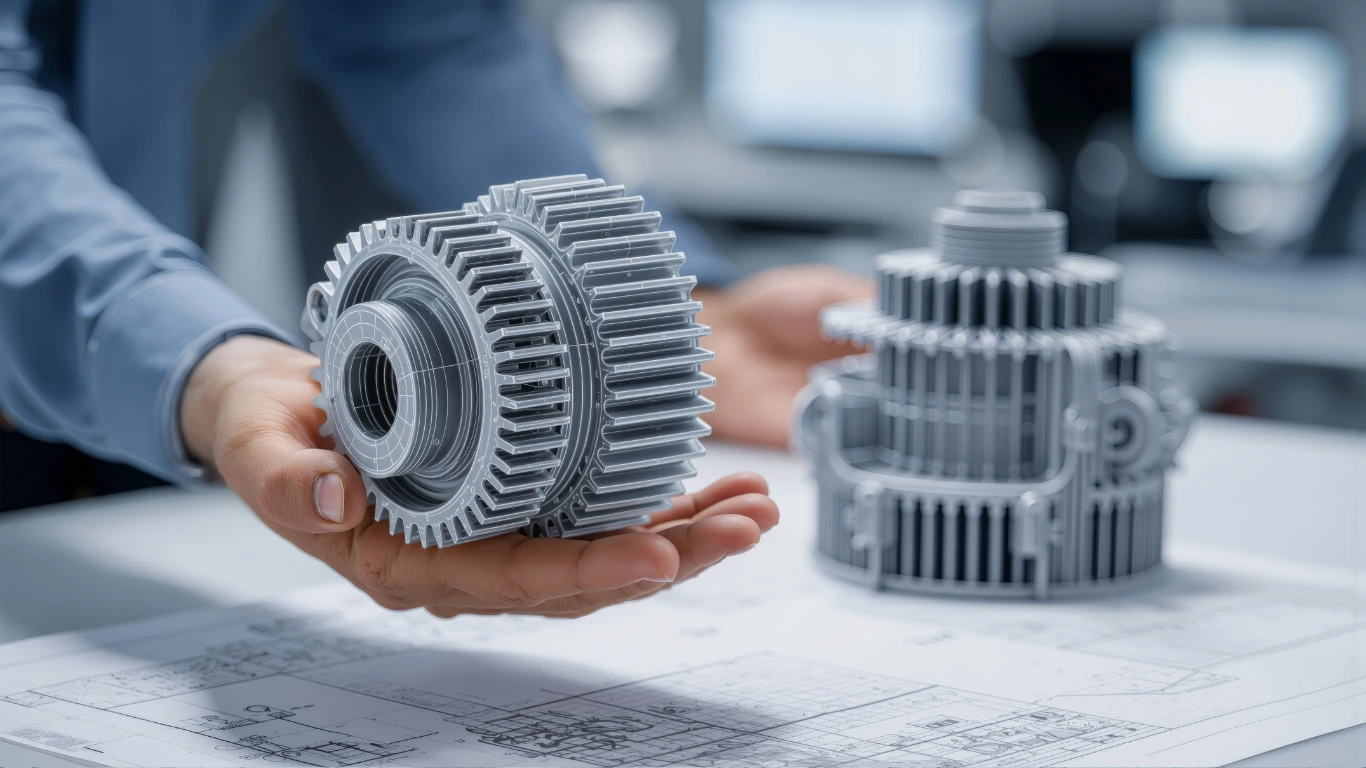
Reverse engineering is the process of working backwards from a physical component or assembly to a complete, accurate, and manufacturable digital definition. The end result is a set of 3D models and production drawings that let you have the part made again by any capable supplier, whenever you need it.
It is not simply copying an old part. A good reverse engineering programme captures three things.
- The geometry. Exact dimensions, tolerances, threads, fits, and surface conditions.
- The intent. Why the part is shaped the way it is, which features are functionally critical, and which are incidental to the original manufacturing method.
- The performance requirements. The loads, speeds, temperatures, and duty cycle the part actually experiences in service.
That third element is what separates a useful reverse engineering project from an expensive photocopy. A worn part scanned and reproduced faithfully will simply fail again in the same way and on the same schedule.
When Reverse Engineering Makes Business Sense
Not every legacy machine is a candidate. The projects that pay off best usually share one or more of the following characteristics.
The spare part is obsolete or unreasonably priced
If a single component controls the availability of an entire production line, having a manufacturable digital definition of that component is a form of insurance. Once the model and drawings exist, the part can be quoted competitively and produced on demand.
The equipment still fits the process
Older machinery is often mechanically overbuilt and well matched to a specific process. If the machine still meets throughput and quality targets, replacing it means paying for capability you do not need, plus installation, commissioning, retraining, and the disruption of a changeover.
Downtime is expensive
Where an hour of lost production carries a meaningful cost, the ability to source a replacement part quickly is worth far more than the engineering effort required to document it.
The design needs to be improved, not just restored
Many legacy components fail predictably because of a known weakness in the original design, or because the machine has been asked to run faster or heavier than intended. Reverse engineering creates the opportunity to fix that permanently.
Compliance or documentation is required
Insurance, safety audits, and regulatory reviews increasingly expect current documentation for equipment in service. For older machines, that documentation frequently does not exist in any usable form.
How the Process Works Step by Step
A structured approach keeps a reverse engineering project predictable and prevents the common failure of producing beautifully detailed models of the wrong thing.
Assess and prioritise
Not every part on a legacy machine needs to be documented. The first step is identifying the components that carry real risk: the wear items, the failure-prone parts, the long lead time items, and the components with no known source. A mechanical design engineer working with your maintenance team can usually build this list quickly.
Capture the geometry
Depending on the part, this may involve precision hand measurement, coordinate measuring, or 3D scanning. Complex organic surfaces such as impellers and housings benefit from scanning. Prismatic machined parts are often measured more accurately by hand. Worn parts require careful judgement, because the measured surface is not the original surface, and the difference has to be reconstructed rather than guessed.
Determine materials and treatments
Material identification, hardness testing, and inspection of coatings or heat treatments matter as much as dimensions. A dimensionally perfect part in the wrong alloy will not survive its first shift.
Rebuild the CAD model
The captured data is turned into a parametric 3D model that reflects design intent rather than the artefacts of measurement. A parametric model can be adjusted later, which is what makes future improvements possible.
Validate with finite element analysis
This is the step that turns restoration into engineering. Finite element analysis lets you apply the real service loads to the new model and see how it behaves before anything is manufactured. It reveals stress concentrations, deflection under load, fatigue-prone regions, and thermal effects that the original designer may have handled by intuition or may not have handled at all. Where a component has a history of failing, finite element analysis usually explains why and points directly to the geometry or material change that will fix it.
Produce manufacturing drawings
Complete drawings with correct GD&T, datums, material specifications, and finish callouts allow any qualified shop to quote and produce the part accurately. This is the deliverable that gives you supplier independence.
Verify the first article
The first manufactured part is measured against the model and, where practical, tested in service. Any variance feeds back into the documentation so that the digital record stays trustworthy.
Restore, or Improve?
One of the most valuable outcomes of reverse engineering is the choice it gives you. Once a validated digital model exists, upgrades become straightforward engineering decisions rather than gambles.
Common improvements include substituting a modern material with better wear or corrosion resistance, replacing an obsolete bearing or seal with a current standard component, adding fillet radii or increasing section thickness where analysis shows stress concentration, simplifying the geometry so the part is cheaper to machine today than it was to cast decades ago, and improving access for maintenance.
Each of these changes should be validated by analysis before production. A component that has been strengthened in one region can shift the failure mode somewhere else, and simulation is how that is caught.
What You Gain Beyond the Part Itself
The immediate deliverable is a replacement component. The lasting benefit is the documentation.
Once your legacy equipment has a current digital definition, you own your spare parts strategy. You can hold fewer physical spares because you can produce them on demand. You can quote across multiple suppliers instead of accepting a single-source price. You can plan upgrades with confidence. And when the engineer who knew that machine best eventually retires, the knowledge does not leave with them.
For many manufacturers, that shift from dependence to control is the real return on the project.
Put Your Legacy Equipment Back in Your Control
CustoMachinery brings more than twenty years of mechanical design experience to legacy equipment, obsolete components, and machinery that no longer has documentation. Our team handles precision measurement, CAD and 3D modelling, finite element analysis, GD&T, and complete manufacturing drawings, delivered as flexible on-demand support that fits around your existing workload.
If there is a machine in your plant that keeps you up at night, or a part you can no longer source, an experienced mechanical design engineer can help you turn it into something you can make again.
See our full range of services or get in touch to discuss your equipment at https://customachinery.com/contact-us/
Frequently Asked Questions
Can a part be reverse engineered if the original is worn or damaged?
In most cases, yes. Wear patterns are usually predictable, and an experienced engineer can reconstruct the original geometry by combining measurements of unworn surfaces, symmetry, standard engineering practice, and mating component dimensions. Having a second sample, an assembly drawing, or the mating parts available improves accuracy considerably. Severely damaged or heavily modified components are harder and should be assessed case by case.
How long does a reverse engineering project take?
It depends on complexity and scope. A single machined component with straightforward geometry can move from measurement to released drawings in a matter of days. A full assembly with dozens of interacting parts, material verification, and finite element analysis is a longer engagement. Prioritising critical parts first means you get protection against your biggest risk early, rather than waiting for a complete documentation set.
Is reverse engineering legal?
Reverse engineering for maintenance, repair, and the production of replacement parts for equipment you own is generally accepted practice in Canada and most jurisdictions. Care is required where active patents, registered designs, or contractual restrictions apply, and it is worth confirming the position before reproducing parts commercially or at scale. A reputable engineering partner will raise this at the outset rather than after the fact.