
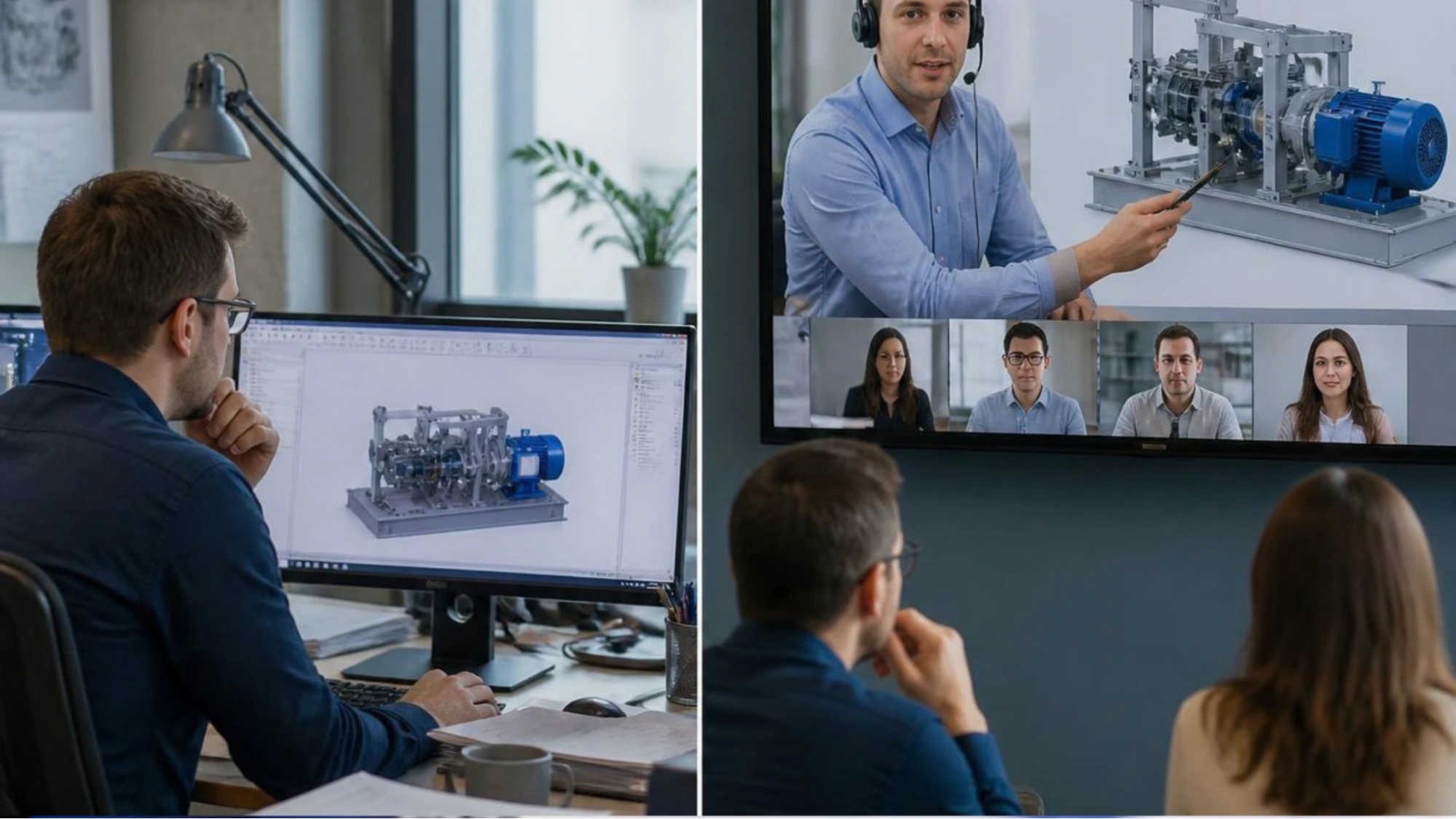
Every manufacturer eventually faces the same decision. A new machine needs designing, a legacy system needs updating, or the current engineering team is already stretched thin. Do you hire another engineer, or bring in outside support?
The answer is rarely about whether engineers are valuable. They are. The real question is how you pay for engineering capacity, and whether you are paying for hours you actually use. Outsourcing mechanical design is not a sign that your team lacks skill. Used well, it is a capacity strategy that lets your people focus on what they do best while specialized work gets done on schedule.
Here is how to tell when on-demand engineering saves money, when in-house is the better choice, and how to run the numbers for your own operation.
The True Cost of an In-House Mechanical Design Engineer
Salary is the most visible cost, but it is only the starting point. A full picture includes:
- Salary, benefits, and payroll costs paid year-round, regardless of workload
- Recruitment time and cost, including the weeks or months a role sits empty
- Software licenses for CAD, simulation, and FEA tools, plus annual maintenance
- Workstation hardware capable of running large assemblies and analysis
- Training and onboarding before the new hire is fully productive
- Management time spent assigning, reviewing, and coordinating work
- Idle capacity between projects, when you are paying for time that produces no design output
That last item is the one most businesses overlook. If your design workload comes in waves, a full-time hire costs the same during the quiet months as during the busy ones.
What On-Demand Engineering Actually Means
On-demand engineering services give you access to qualified mechanical design expertise for a defined scope, without a permanent hire. You pay for the work delivered, not for the calendar. As CustoMachinery puts it on our homepage, many businesses do not need a full-time engineer on staff, and flexible support with no long-term commitment can fit both schedule and budget.
A good engineering partner works alongside your existing team and processes. They take on a project, a phase, or overflow work, and hand back complete, usable deliverables your team owns.
When Outsourcing Mechanical Design Saves You Money
Your Workload Is Project-Based or Seasonal
If design work spikes around new equipment builds, customer orders, or capital projects and then drops off, outsourcing lets your engineering cost rise and fall with actual demand.
You Need Specialized Expertise Occasionally
Some skills are essential but not needed every week. Structural analysis through CAD, 3D modeling, and FEA, thermal management solutions, detailed GD&T and manufacturing drawings, and SR&ED technical report writing all require depth. Hiring for each one rarely makes financial sense. Accessing them on demand does. If you are unsure which skills a project calls for, our breakdown of the top skills a mechanical design engineer brings to your project is a useful reference.
Your Team Is at Capacity
When a critical project lands on a team that is already fully booked, something slips. Overflow support lets you meet the deadline without burning out your staff or delaying other commitments. Your engineers stay focused on core work while an outside partner handles the extra load.
You Are Updating or Replacing Legacy Equipment
Older machines often have missing or outdated drawings. Reverse engineering legacy machinery is a defined, finite project, which makes it a natural fit for outside engineering support rather than a new permanent role.
Speed to Market Matters
An experienced partner can start immediately, without a recruitment cycle or ramp-up period. When a delayed design means a delayed launch or a missed customer order, that time has a real dollar value.
When Building In-House Makes More Sense
Outsourcing is not always the right answer. An in-house engineer is often the better investment when:
- Design work is continuous and fills a full schedule year-round
- Your core product requires constant daily iteration and close contact with production
- Engineers need to be physically present on the floor for ongoing support
Even in these cases, most growing manufacturers still benefit from outside support for peak periods and specialized tasks.
The Hybrid Model Most Manufacturers Land On
In practice, the most cost-effective structure is usually a combination. A lean internal team owns product knowledge, day-to-day decisions, and production support. An external mechanical design consultant supplies capacity and specialized skills when projects demand it. This keeps fixed costs under control while making sure no project waits for resources. To understand how external engineers contribute at a strategic level, read the strategic role of a mechanical design engineer in complex machinery projects.
A Simple Framework to Run the Numbers
Use these steps to compare options for your own business:
- Estimate your real annual design hours. Review the last two to three years of projects, not your busiest month.
- Calculate the fully loaded in-house cost. Add salary, benefits, software, hardware, training, and management time.
- Divide cost by productive hours. This gives you your effective in-house hourly cost at actual utilization, which is often higher than expected.
- Request quotes for typical projects. Compare the outsourced cost of the work you actually do against your effective in-house cost.
- Factor in time and risk. Include the cost of delays, missed deadlines, and gaps in specialized skills.
The same long-term thinking applies to equipment decisions. Our 5-year cost-benefit analysis of custom machinery vs standard equipment uses a similar approach.
What to Look for in an Engineering Partner
- Professional credentials, such as authorization by Professional Engineers Ontario
- Complete, usable documentation including native CAD files and manufacturing drawings you can reuse
- Transparent pricing that is fair for small projects as well as large ones
- Relevant project history you can review, such as a featured projects portfolio
- Clear communication and the ability to work within your existing processes
CustoMachinery is a Mississauga-based mechanical engineering design consultancy with more than 22 years of experience and PEO authorization. We provide on-demand and overflow engineering support across our full range of mechanical design services, with transparent, competitive pricing and deliverables your team can build on.
Get Engineering Capacity Without the Overhead
If your team is stretched, your workload is uneven, or a specialized project is waiting on resources, on-demand engineering may be the most cost-effective path forward. Book a free consultation with CustoMachinery. We will review your project, scope the work, and give you a clear quote so you can compare it against your in-house costs with confidence.
Request your quote today: https://customachinery.com/contact-us/
Frequently Asked Questions
Is outsourcing mechanical design cheaper than hiring an engineer?
It often is when design work is project-based, seasonal, or requires specialized skills only occasionally. When you factor in benefits, software, hardware, and idle time, the effective hourly cost of an in-house engineer is frequently higher than it first appears.
Will an outside engineering partner work with our existing team?
Yes. On-demand engineering is designed to add capacity, not replace your team. A good partner adapts to your processes, handles overflow or specialized work, and delivers documentation your engineers can use and build on.
What types of projects are best suited to on-demand engineering?
New machine designs, legacy equipment redesigns, FEA and thermal analysis, manufacturing drawing packages, GD&T, and SR&ED technical reports are all strong fits. Any well-defined project with a clear scope and timeline works well with an outsourced model.